Explore our network of country and industry based websites to access localized information, product offerings, and business services across our group.
Log in to start sending quotation requests for any product.
Don't have an account? Sign Up Here
Home Gum Turpentine Oil in Indonesia: Industry Supply Chain
Trade Insights | Supply Chain | 08 June 2026
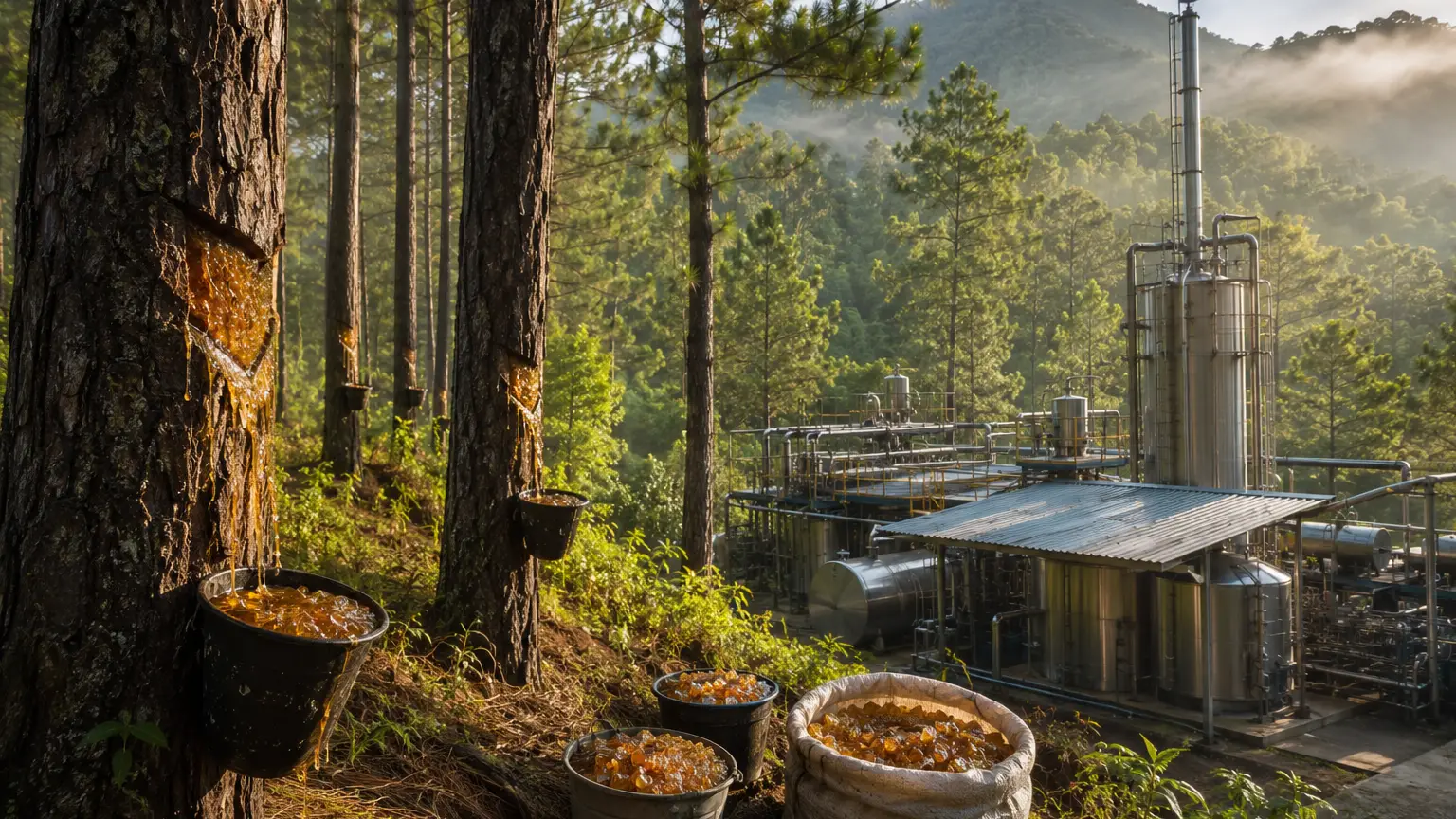
Indonesia is the world's third-largest gum rosin and turpentine oil producer, behind China and Brazil, with virtually all domestic output derived from Pinus merkusii — a tropical pine native to Sumatra and Java. Perum Perhutani, a state-owned forestry enterprise, dominates the supply chain from resin tapping through steam distillation and export, producing approximately 65,000 metric tons of gum rosin annually with turpentine oil as a co-product (15–25% yield from processed oleoresin). Around 80% of Indonesia's gum rosin and turpentine oil output is exported to markets including Japan, India, Spain, the United States, Germany, and Singapore.
Indonesia's gum turpentine oil supply chain is more vertically concentrated than almost any other major producer market. In China — the world's largest producer — pine chemical production is fragmented across hundreds of private processors and provincial resin cooperatives. In Indonesia, a single state-owned enterprise, Perum Perhutani, controls the dominant share of Pinus merkusii forest management, oleoresin tapping, and gum chemical processing across Java. That concentration creates supply chain predictability for international buyers but also a single point of institutional risk — a dynamic that becomes important when evaluating Indonesian-origin turpentine against Chinese or Brazilian alternatives.
Indonesian gum turpentine oil is derived exclusively from Pinus merkusii oleoresin, not from the Pinus sylvestris or Pinus pinaster species that dominate European and South American production respectively. This species distinction has direct implications for chemical composition and end-use performance. Indonesian P. merkusii turpentine is rich in α-pinene — typically 73–74% by composition — with lower β-pinene content than most Chinese-origin turpentine. For downstream buyers in the fragrance and fine chemical sector where α-pinene is the primary terpene feedstock for camphor, linalool, and borneol synthesis, Indonesian-origin material offers a consistently high α-pinene concentration profile.
P. merkusii also delivers resin with a lower acid value and higher softening temperature than most temperate-climate pine species. For adhesive and paint formulators that require rosin and turpentine with specific viscosity and hardening characteristics, these properties make Indonesian origin material a technically differentiated product — not simply a commodity substitute for Chinese supply.
Pinus merkusii plantations are concentrated in Java (managed by Perhutani under its Forest Management Unit system), Sumatra (Aceh, Tapanuli, Kerinci), and to a lesser extent Sulawesi. Average annual pine resin production across Indonesia ran approximately 115,730 metric tons per year between 2015 and 2018, per Ministry of Environment and Forestry data — a baseline that broadly held through the early 2020s despite some plantation aging pressure in older Java stands.
Oleoresin collected by tappers across Perhutani's Java concessions is transported to a network of Pabrik Gondorukem dan Terpentin (PGT) — gum rosin and turpentine processing facilities. The primary processing hub is located in Pemalang, Central Java, which operates as the main steam distillation facility converting raw oleoresin into gum rosin (gondorukem) and turpentine oil (terpentin).
The distillation process yields approximately 70–80% gum rosin and 15–25% turpentine oil by weight from input oleoresin. Both products are co-produced in fixed ratio from the same feedstock batch, meaning turpentine supply is structurally linked to rosin demand — a supply dynamic distinct from sulfate turpentine (a byproduct of the kraft pulp process) where production is decoupled from rosin markets.
Gum rosin and turpentine oil production accounts for approximately 45% of Perhutani's total revenue, per institutional reporting, reflecting the commercial significance of pine chemicals to the enterprise's financial model. Private processors — including CV. Indonesia Pinus — operate alongside Perhutani, sourcing both Perhutani-origin resin and their own tapped supply from Java, Sumatra, and Sulawesi plantations. These private operators supply both domestic industrial buyers and international traders, providing buyers an alternative sourcing channel to Perhutani direct or government-authorized export arrangements.
Paints, Coatings, and Varnishes are the largest industrial application for gum turpentine oil globally and in Indonesia. Turpentine functions as a natural solvent with excellent compatibility with alkyd resins and oil-based paint formulations. Its quick evaporation rate and bio-based origin give it a procurement advantage over petroleum-derived mineral spirits in markets where VOC regulations or green procurement specifications favor renewable solvents. Indonesian paint manufacturers — including PT Nippon Paint Indonesia and PT ICI Paints Indonesia — use turpentine as a solvent and thinner component in architectural and industrial coating lines. Export-oriented turpentine from Perhutani's PGT facilities also supplies paint raw material buyers in Japan and Spain who have long-standing import relationships with Indonesian pine chemical producers.
Fragrance and Fine Chemicals represent the highest-value downstream application channel. Turpentine oil is the primary industrial source of α-pinene, the terpene precursor used to synthesize synthetic camphor, linalool, geraniol, borneol, and a range of aroma chemicals used in perfumery, personal care, and cleaning product formulations. Perhutani's Pemalang facility is noted as the only domestic processing point for turpentine derivatives in Indonesia — meaning that most α-pinene extracted from Indonesian turpentine for fine chemical synthesis is processed by international buyers after import, not within Indonesia's domestic chemical sector. This represents a value-addition gap that downstream chemical developers have identified as an opportunity.
Adhesives and Printing Inks consume turpentine-derived terpene resins and modified rosin esters. Adhesive manufacturers using hot-melt and pressure-sensitive adhesive formulations source turpentine derivatives as tackifier inputs. Indonesia's packaging sector — growing in line with e-commerce and processed food expansion — drives domestic adhesive demand, though most turpentine used in this application chain enters as imported terpene resin rather than crude turpentine oil processed domestically.
Procurement teams sourcing gum turpentine oil for paint, fragrance, or adhesive applications from Indonesian supply chains need consistent α-pinene assay documentation, refractive index confirmation, and specific gravity certification to verify grade compliance across shipments. Tradeasia International, a Singapore-headquartered global chemical distributor with more than 20 years of supply chain experience, supplies gum turpentine oil to industrial buyers across Southeast Asia and beyond, with batch-specific certificates of analysis, multi-origin sourcing capability, and logistics coordination through Chemtradeasia Indonesia. Buyers can contact Tradeasia International for grade specifications, purity documentation, and volume pricing on Indonesian-origin gum turpentine oil.
Approximately 80% of Indonesia's gum rosin and turpentine oil output is exported. The primary receiving markets — Japan, India, Spain, Germany, the United States, Singapore, and the United Kingdom — reflect a buyer base concentrated in high-value manufacturing sectors: flavors and fragrances (Japan, Germany), industrial adhesives and coatings (Spain, US), and chemical distribution and re-export (Singapore). Indonesia's Ministry of Trade data tracks pine chemical export values that showed an increasing trend through the 2015–2018 period, with the broader pine chemicals export category generating USD 68.6 million across that interval.
Indonesian turpentine's export competitiveness rests on three structural advantages: P. merkusii's high α-pinene content relative to most Chinese-origin material, Perhutani's institutional supply reliability as a state enterprise, and price competitiveness relative to European producers. The risk side of this picture is plantation aging — particularly in older Java concessions — and resin yield variability from tapper labour constraints, both of which periodically tighten available supply and widen CFR price spreads between Indonesian and Chinese origin material.
For industrial buyers managing procurement across multiple origin regions, Indonesian turpentine oil is a technically differentiated product worth maintaining as a sourced alternative alongside Chinese supply — particularly for fragrance and fine chemical buyers where α-pinene specification tightness justifies the origin premium. Tradeasia International supplies gum turpentine oil to fragrance formulators, paint manufacturers, and chemical compounders across Asia with documentation support including origin certificates, COA by batch, and MSDS compliant with importing country requirements. Buyers can contact Tradeasia International for current availability, origin options, and procurement terms.
We're committed to your privacy. Tradeasia uses the information you provide to us to contact you about our relevant content, products, and services. For more information, check out our privacy policy.


 English
 Indonesian
 简体字
简体字
 العربية
 Español
 Français
 Português
 日本語
日本語
 한국어
한국어
 Tiếng Việt



















